
Deploying a unified framework that balances SEO vs PPC vs SMO: Top Digital Marketing Strategy allocation is the absolute baseline requirement for any enterprise aiming to control its digital market share and maximize capital efficiency. Throughout my 14+ years managing enterprise-level growth, I have watched countless brands make the fatal mistake of treating Search Engine Optimization (SEO), Pay-Per-Click (PPC), and Social Media Optimization (SMO) as isolated channels. In reality, working with a sophisticated Digital Marketing Agency reveals that these tools are highly codependent parts of a single conversion ecosystem. Brands that over-index on a single channel remain structurally vulnerable to sudden algorithm shifts, rising ad costs, or platform fatigue.
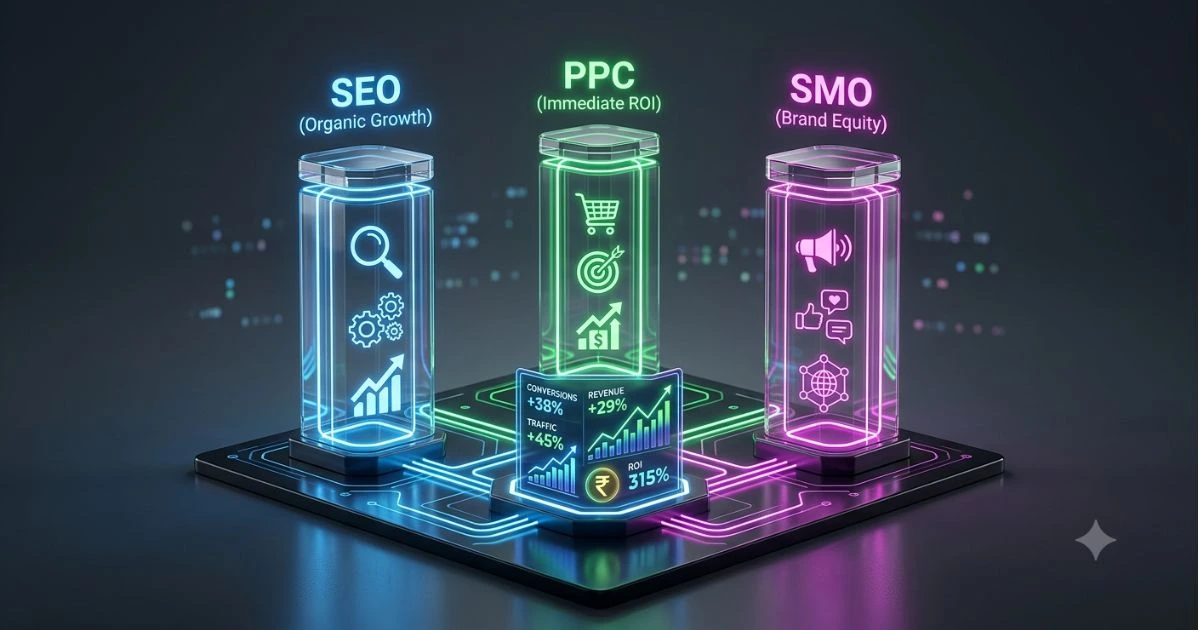
Deconstructing the Core Conversion Pillars
To extract the highest yield from your marketing budget, you must first strip away the vanity jargon and analyze the precise structural role each channel occupies within your modern marketing funnel.
1. Search Engine Optimization (SEO)
SEO represents your digital real estate investment. The primary objective is establishing unshakeable organic authority on search engines like Google so you capture high-intent users without paying a direct toll for every click.
Modern enterprise SEO goes far beyond basic meta tags; it requires deep technical asset optimization, including managing core web vitals, deploying advanced schema graphs, and structuring content into strict semantic topical clusters. It is the definitive long-term play for driving down your blended Customer Acquisition Cost (CAC).
2. Pay-Per-Click Advertising (PPC)
PPC acts as your precision-targeted customer acquisition engine. Utilizing high-performance paid networks—including Google Ads, YouTube Ads, and programmatic display networks—PPC allows you to buy immediate placement at the absolute peak of user search intent.
The strategy gives you total granular control over demographics, geographical location, device types, and explicit search queries. While it demands continuous capital deployment, it is an invaluable tool for driving immediate revenue, testing market viability, and fueling cash flow while long-term organic assets mature.
3. Social Media Optimization & Marketing (SMO/SMM)
SMO forms the emotional bedrock of your brand equity. While search channels catch users who are already actively looking for a solution, social platforms like Instagram, LinkedIn, and YouTube allow you to engineer demand.
By utilizing targeted community building, strategic creator partnerships, and high-retention short-form video assets, SMO fosters direct user engagement, builds deep consumer trust, and maximizes your customer retention metrics.

A professional close-up photograph of a business intelligence dashboard running on a high-end dual-monitor setup in a dimly lit executive office. The screens display side-by-side analytical comparisons of organic traffic curves, paid ad conversion funnels, and social media engagement rates, all showing synchronized upward growth. Clean reflection on the desk surface, cinematic lighting, shallow depth of field.
The Strategic Balance: Allocation Matrices by Scale
An elite digital marketing team never guesses where to allocate capital. Budget distribution must shift dynamically based on your brand's market maturity, cash flow requirements, and long-term valuation goals.
| Business Maturity Stage | SEO Allocation | PPC Allocation | SMO Allocation | Core Strategic Objective |
| Early-Stage Startups | 20% | 50% | 30% | Aggressive market validation, immediate lead capture, and early brand discovery. |
| Mid-Market Scale | 40% | 35% | 25% | Scaling organic real estate while maintaining steady paid pipeline velocity. |
| Enterprise Leaders | 45% | 25% | 30% | Defensive market dominance, maximizing lifetime value (LTV), and deep brand equity. |
Why Single-Channel Reliance Invites Funnel Failure
Relying exclusively on a single digital channel exposes your corporate pipeline to catastrophic systemic risk. Consider the distinct operational bottlenecks of a fragmented strategy:
- The SEO-Only Pitfall: While organic traffic boasts exceptional long-term ROI, it moves slowly. Relying solely on SEO means waiting months for significant visibility, leaving your brand highly vulnerable to sudden core search algorithm updates.
- The PPC-Only Trap: Paid media delivers instant scale, but it operates purely on a cash-in, cash-out basis. The moment you lower your ad spend, your traffic stops instantly. Additionally, as markets crowd, rising cost-per-click (CPC) metrics can rapidly crush your margins.
- The SMO-Only Blindspot: Social platforms excel at building communities, but they lack the immediate, high-conversion intent of search queries. Users browsing social feeds are there for entertainment, meaning conversion pathways are naturally longer and less linear.
About us and this blog
We are a digital marketing company with a focus on helping our customers achieve great results across several key areas.
Request a free quote
We offer professional SEO services that help websites increase their organic search score drastically in order to compete for the highest rankings even when it comes to highly competitive keywords.
Subscribe to our newsletter!
More from our blog
See all posts

Recent Posts
- How to Choose the Best Website Design Company July 27, 2026
- Best Google Ads Service Provider: Actionable Guide July 27, 2026
- How to Start as a Digital Marketing Freelancer : 2026 Guide July 27, 2026